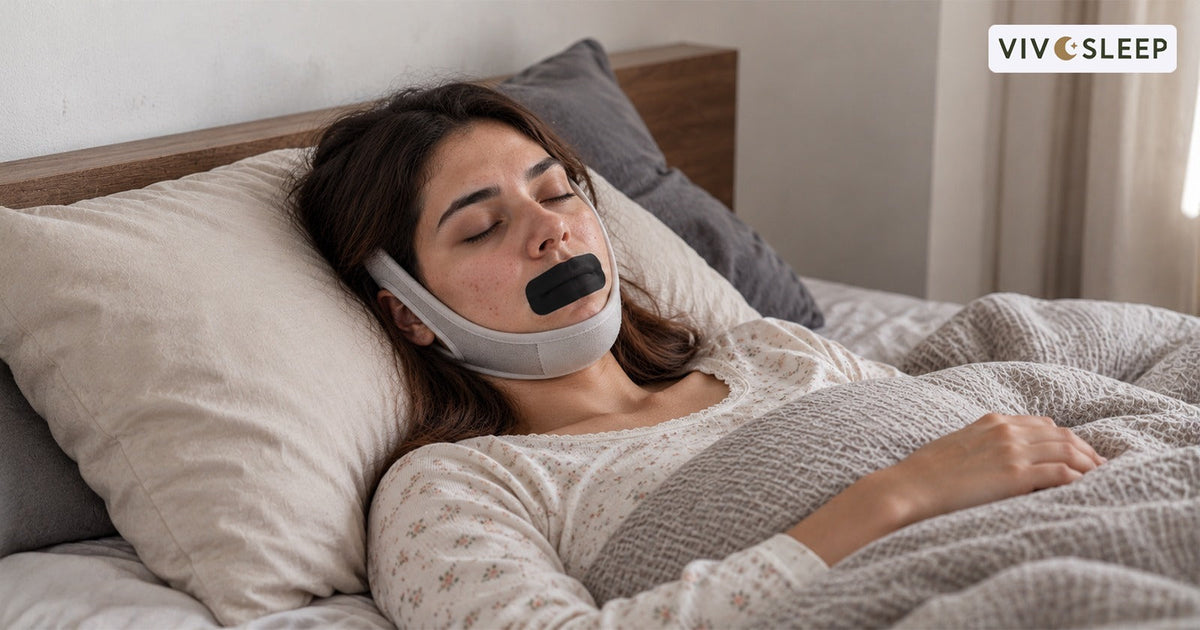
Is Mouth Taping Safe? What the Research Actually Shows

People use mouth taping to help manage mouth breathing, dry mouth, or snoring, and it is a popular sleep trend. Keeping the lips closed can encourage natural nasal breathing. However, is mouth taping safe, and is there research supporting the claims of what's on the internet?
Current evidence is much more cautious than social media advice. Based on a 2025 systematic review, there is limited research available, and there are safety concerns with mouth taping if nasal obstruction or regurgitation is a risk.
Mouth tape can be used as a wellness aid for open-mouth sleeping in healthy adults who are breathing easily through the nose. For this nighttime routine, there is a mouth tape for sleep that has been designed by VivoSleep.
Quick Answer: Mouth taping can have a low risk for some healthy adults who can breathe through their nose; research is limited. Do not use for people with a blocked nose, chronic congestion, untreated or suspected sleep apnea, breathing difficulties, nausea or vomiting risk, severe reflux, or difficulty with the use of a mouth covering. It has not been proven to treat sleep apnea.
Why Do People Try Mouth Tapes?

Mouth taping is a technique that people use for sleep apnea, dry mouth, nasal breathing support, and/or light snoring. Mouth tape helps with breathing through the nose but doesn't necessarily help with all underlying causes.
Encourages closed-mouth sleep: If breathing through the nose is clear and comfortable, using mouth tape can help to encourage closed-mouth sleep.
Dry mouth management: Open mouth sleepers can cause dry mouth. It can also be due to medications, dehydration, and lack of saliva. Understanding the underlying cause can help determine the right approach for dry mouth at night.
Supporting nasal breathing: Nasal breathing is a process that warms, humidifies, and filters incoming air. Mouth tape is only recommended if the nasal passages are not blocked.
Light snoring: For some sleepers who snore lightly due to open-mouth sleeping, using a mouth tape will help reduce the snoring. It does not treat every cause of snoring.
Is Mouth Tape Safe for Sleep?
Mouth taping is not equally safe for everyone. The most important requirement is clear, comfortable nasal breathing before the mouth is covered.
| Situation | Mouth Taping Safety | Better Next Step |
| Clear nasal breathing | May be considered carefully | Test comfort first |
| Mild dry mouth | May help selected users | Check why the mouth opens |
| Blocked nose | Avoid | Improve nasal airflow first |
| Chronic congestion | Avoid unless medically cleared | Check allergy or nasal cause |
| Untreated sleep apnea | Avoid | Speak with a sleep specialist |
| Gasping or choking at night | Avoid | Seek medical evaluation |
| Skin irritation | Stop use | Choose another approach |
Note: If nasal breathing is clear, it's safe to consider mouth taping. It is not recommended for use if nasal obstruction, untreated sleep apnea, difficulty breathing, gasping or choking is present. People often try mouth taping for nighttime mouth breathing, dry mouth, nasal breathing support, or light snoring.
What Does the Research Actually Show About Mouth Taping?

Research on mouth taping is small, mixed, and still developing. That matters because online claims often go much further than the available evidence. The strongest current message is not that mouth taping “works” or “does not work.” It is that results appear to depend heavily on who uses it, why they mouth-breathe, and whether nasal airflow is already clear.
Current Evidence Is Limited
A 2025 systematic review evaluated research on mouth taping for mouth breathing, sleep-disordered breathing, and obstructive sleep apnea. The review found that evidence remains limited and noted potential risks when nasal breathing is obstructed or regurgitation occurs, as discussed in the full research on PMC.
Small Studies Show Possible Benefits in Selected People
A preliminary study involving mouth breathers with mild obstructive sleep apnea reported improvements in apnea-hypopnea index and snoring after mouth taping. However, this was a small, selected group. It does not establish that mouth tape is safe or effective for everyone with snoring or sleep apnea.
Research Does Not Prove Universal Safety
A product can produce improvement in one selected population without being appropriate for everyone. Those suffering from congestion, airway blockage, reflux risk, breathing problems or suspected sleep apnea are very different in terms of safety concerns from healthy adults with uncomplicated open-mouth sleeping.
Higher-Quality Research Is Still Needed
There are a number of limitations to the current study, specifically a lack of larger, randomized studies to better understand who may benefit, what risks are involved, and if there's any long-term improvement.
Research Summary: There is no current evidence to support mouth taping as a treatment or remedy for sleep or snoring disorders. Some studies suggest some benefit in certain individuals, but mouth taping may be reasonable only if nasal breathing is clear and there are no conditions that make mouth closure unsafe.
What Benefits Might Mouth Taping Offer Some People?
Potential benefits should be described carefully. Mouth taping may help certain people, but the effect depends on why the mouth opens during sleep.
Less Open-Mouth Breathing
For someone who can breathe freely through the nose but tends to sleep with the lips apart, tape may encourage the mouth to remain closed. It will not resolve mouth breathing caused by nasal obstruction.
Less Dry Mouth in Selected Users
Reducing open-mouth airflow may decrease morning dryness for some sleepers. If dry mouth continues, other causes such as medications, hydration, or health conditions should also be considered.
Support for Nasal Breathing Habits
Mouth tape may serve as a behavioral reminder to keep the lips closed. That is very different from treating the underlying reason nasal breathing may be difficult.
Possible CPAP Mouth-Leak Support
Some people using nasal CPAP interfaces struggle with mouth leak. This should be managed with clinician guidance because mask type, pressure settings, humidification, chin straps, or other approaches may be more appropriate.
Possible Snoring Improvement in Selected Cases
Some open-mouth snorers might find it more beneficial to keep their mouths closed. Even if a person snores regularly or intensely, the cause of the snoring should be evaluated and not taken for granted that it is due to an open mouth.
Consider: Skin-safe adhesive, easy removal, comfortable overnight hold, and clear safety instructions when selecting mouth tape. Do not use strong household tape, or anything that causes any difficulty in breathing.
Who Should Not Use Mouth Tape?
Mouth tape should not be used if breathing through the nose is unreliable or another condition precludes mouth closure. The identification of the reasons for mouth breathing is particularly important before attempting to eliminate mouth breathing mechanically.
| Avoid Mouth Tape If You Have | Why |
| Blocked nose | Nasal breathing may not be reliable |
| Chronic congestion | Mouth airflow may still be needed |
| Untreated sleep apnea | Mouth tape does not treat the condition |
| Gasping or choking | Requires medical assessment |
| Breathing difficulty | Airflow restriction may be unsafe |
| Severe reflux or vomiting risk | Oral closure may create added risk |
| Adhesive sensitivity | Skin may become irritated |
| Anxiety around mouth covering | May disturb sleep or trigger panic |
Quick Answer: Do not use the mouth tape if you have a blocked nose, chronic nasal problems, untreated or suspected sleep apnea, breathing problems, gasping or choking while sleeping, and/or high anxiety of using mouth tape that covers their mouth.
How Can You Use Mouth Tape More Safely?

Even for healthy adults, mouth tape, clear nasal breathing, appropriate tape and a trial of caution are important. Mouth taping should be comfortable and should not cause any restriction of breathing.
Test Nasal Breathing While Awake First
Sit comfortably, and breathe through the nose for a short period of time before using mouth tape. Mouth tape should never be used if nasal breathing is difficult, restricted, or uncomfortable.
Use Skin-Safe Sleep Tape
Choose tape designed for skin contact rather than household, packing, or strong adhesive tape. A gentle adhesive can reduce pulling and irritation around the lips.
Start With a Small or Vent-Friendly Design
A smaller strip or product designed with a center opening may feel less restrictive for some users. The goal should be gentle support for lip closure rather than tightly sealing the mouth.
Try It While Awake Before Overnight Use
Test the tape for a short period while awake before considering nighttime use. This makes it easier to assess breathing, adhesive comfort, removal, and any feelings of anxiety.
Stop if Breathing or Skin Problems Occur
Remove the tape if you experience restricted breathing, panic, significant discomfort, itching, redness, or skin irritation. Comfort should not be ignored simply to continue the routine.
Avoid Use When Congested or Unwell
Do not use mouth tape when you have a cold, blocked nose, significant allergy congestion, nausea, or another condition that could interfere with comfortable breathing or safe use.
Consider: If you choose to try mouth tape, first confirm that you can breathe comfortably through your nose while awake. Use skin-safe tape, test it briefly before sleep, and stop immediately if breathing feels restricted or the tape causes panic or significant skin irritation.
How Can VivoSleep Support a Safer Nighttime Routine?
VivoSleep products are designed to promote wellness and comfort during sleep but are not intended to treat disease. Vivo Mouth Tape is designed for use by adults who are already comfortable breathing through their nose. Mouth tape may help keep the mouth closed during sleep, while VivoSleep Nose Strips are intended to support airflow through the nose.
When selecting a product, look for one that addresses the issue that concerns you, not just one symptom. Avoid using mouth tape if it causes discomfort in breathing or when you are congested. These products are not intended to substitute for medical treatment for sleep apnea or other chronic breathing disorders. If you are not sure what VivoSleep products to use, you can reach out to get expert guidance.
Conclusion
Taping the mouth can help a few healthy adults who are breathing comfortably through their noses, and research is still ongoing. It should not be used as a treatment for sleep apnea, chronic snoring, nasal blockage, or other sleep-related problems. Your nasal airflow, comfort, and individual health should always be considered before using mouth tape.
If you are going to use mouth tape, make sure you use a skin-safe tape, test it thoroughly, and stop using it if breathing gets difficult or if you feel anxious or irritated. When sleep apnea is suspected, and you have long-standing snoring, apnea, or choking, you must get medical advice, not a sleep trend or a wellness product.
Frequently Asked Questions About Mouth Taping
Is Mouth Taping Safe for Sleep?
Some healthy adults who can breathe comfortably through their nose may want to consider mouth taping. Should not be used if there are breathing difficulties with the nose, sleep apnea, or if there is a suspicion of sleep apnea or other breathing problems.
Does Mouth Tape Work for Snoring?
In those who snore because mouth breathing is open, but blocked nasal passages are not a problem, it can help to reduce snoring. It does not treat every type of snoring and should not be considered a replacement for evaluation if the snoring is chronic or troublesome.
Who Should Not Use Mouth Tape?
It is not recommended for people with nasal breathing conditions, chronic congestion, untreated or suspected sleep apnea, difficulty breathing, or high risk of reflux or vomiting, or those who are concerned about the need for the mask to cover their mouth. Mouth tape is not recommended for children unless recommended by an appropriate clinician.
Is Mouth Tape Better Than Nose Strips?
They work differently. Mouth tape keeps the lips closed, while nose strips help open the nasal passages to support breathing through the nose. If the main problem is nasal breathing, the first course of action is to treat the nose.
Does Mouth Tape Work for Dry Mouth?
It can help to decrease the amount of dry mouth in the morning for some individuals with open-mouth sleeping. However, dry mouth can be caused by other issues, including some medications, dehydration, or health issues.
Which is the best tape for mouth taping?
Use gentle, non-irritating tape that will lift off skin easily. Do not use products in the household like packing tape or duct tape.
Should Children Use Mouth Tape?
The use of mouth tape should be avoided in a routine practice without supervision by an appropriate health care professional. Breathing through the mouth can be a chronic problem in children, with underlying issues that should be properly assessed.
When is it time to see a doctor for snoring?
If the snoring is frequent and loud, especially if there are pauses in breathing or gasps or choking sounds, headaches in the morning or daytime sleepiness, see a doctor for advice. Such symptoms may be related to sleep-disordered breathing.