What Percussive Therapy Does for Recovery, and What It Doesn’t
Percussive therapy has become a common part of many recovery routines. Massage guns are easy to use at home, at the gym, and while traveling. They use rapid pulses to target specific muscle groups.
But healing involves more than just providing short-term relief from tense muscles. Your body is also impacted by other elements such as training load, sleep, diet, hydration, movement, and recovery time.
According to the research, percussion therapy may aid in temporary healing. It enhances range of motion, flexibility, and final results.
That distinction matters. A recovery massage gun can be one tool within a broader routine, but it should not be presented as a replacement for rest, rehabilitation, or medical care.
Quick Answer: What Does Percussive Therapy Do for Recovery?
Percussive therapy gives muscles a series of rapid, targeted pulses. From a practical perspective, it can make the muscles feel relaxed after working out and can aid with short-term mobility, but it is not a panacea for muscle soreness, injuries, or recovery issues.
| Question | Practical Answer |
| Help tight muscles? | May temporarily reduce stiffness. |
| Support flexibility? | Some studies show short-term ROM gains. |
| Reduce soreness? | Possibly, but results are mixed. |
| Improve recovery? | Some short-term recovery measures may improve. |
| Heal injuries? | No. Injuries need proper assessment. |
| Replace stretching? | No. It serves a different purpose. |
| Replace physical therapy? | No. Persistent symptoms need professional care. |
What Is Percussive Therapy and How Does a Massage Gun Work?
Percussive therapy is the repeated application of rapid mechanical pulses to soft tissue. A massage gun delivers these pulses through a moving attachment placed over a muscle. The sensation can range from a light, vibration-like touch to stronger percussion. This depends on device speed, attachment, pressure, and the muscle area.
How Does a Massage Gun Apply Percussion?
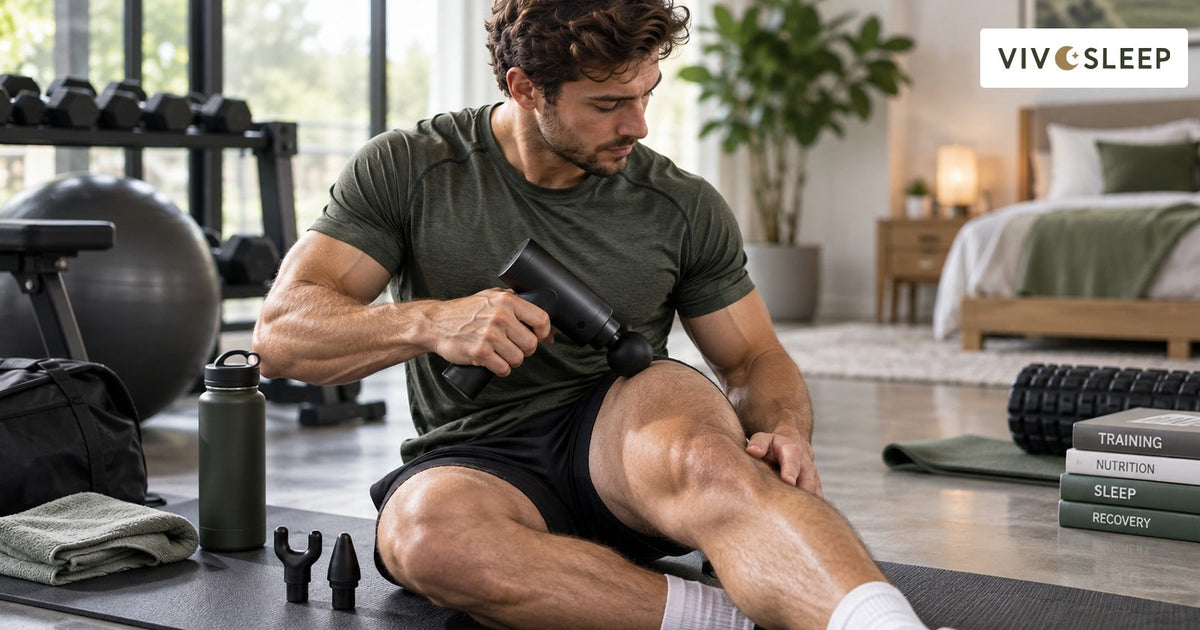
A massage gun repeatedly moves its attachment in and out against the muscle. Instead of manually kneading a large area, the device delivers repeated mechanical stimulation to a targeted location. Users can move the device across calves, quadriceps, hamstrings, glutes, shoulders, and other suitable muscle areas.
What Is the Difference Between Percussion and Vibration?
Although both vibration and percussion rely on swift mechanical movements, their physiological sensations vary significantly. While vibration offers a mild, surface-focused stimulation, percussion delivers concentrated, deep-tissue pulses.
| Feature | Percussion | Vibration |
| Movement | Repeated tapping motion | Fast surface-level oscillation |
| Depth | Reaches deeper muscle tissue | Works more on the surface |
| Feel | Stronger, more targeted | Gentler, lighter sensation |
| Best For | Tight muscles and post-workout use | Relaxation and sensitive areas |
| Control | Often uses multiple intensity levels | Usually feels smoother and less intense |
Do You Know? There is no universal massage-gun timing rule. Start with short, light use, keep the device moving, and follow the manufacturer's instructions. Avoid extending a session simply because the muscle remains sore.
What Can Percussive Therapy Help With?

The strongest practical use cases involve short-term muscle comfort and mobility rather than injury treatment. How someone responds depends on the muscle, exercise, pressure, duration, and individual sensitivity.
Short-Term Muscle Tightness
Percussion may make a muscle temporarily feel less stiff or restricted. This can be useful after sitting, training, or repetitive activity when the problem feels like ordinary muscle tightness rather than injury.
Post-Workout Muscle Comfort
Gentle massage-gun use may feel comfortable after exercise. The above research has examined massage guns in recovery settings, although pain and soreness findings are not consistent enough to promise relief.
Warm-Up Mobility
Short massage-gun sessions may support range of motion before exercise. This does not mean every athlete should use percussion immediately before every activity. The type of exercise still matters.
Cool-Down Relaxation
Some people enjoy gentle percussion after exercise because the rhythmic stimulation feels relaxing. This is a comfort-focused use rather than proof that the muscle is recovering faster.
Targeted Muscle Areas
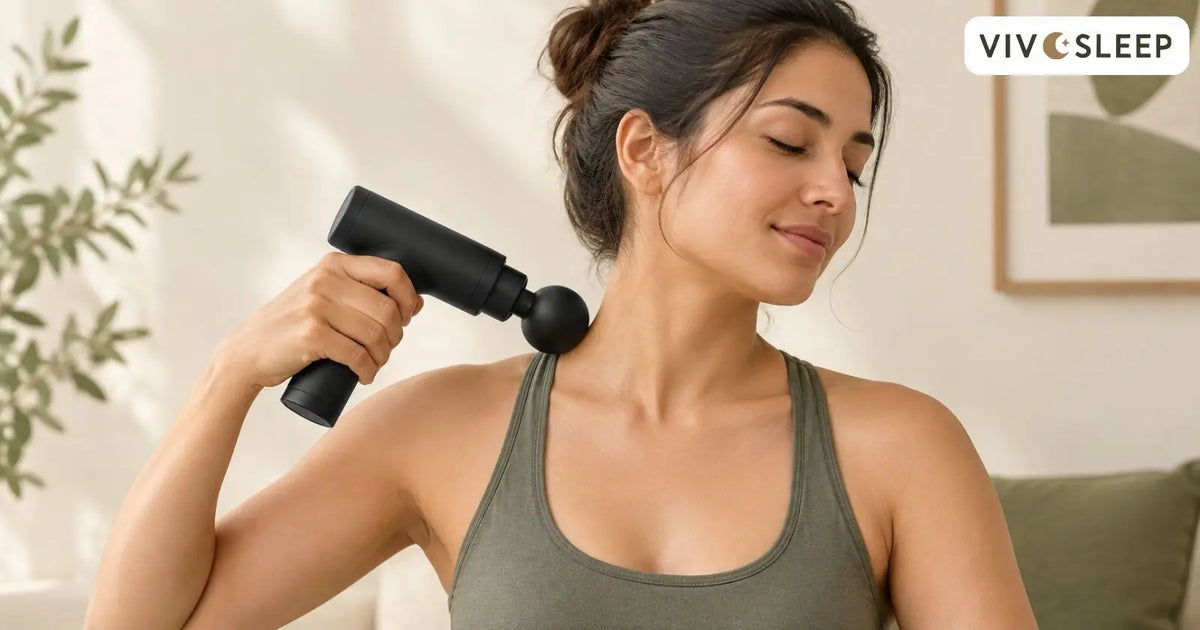
Massage guns make it easier to focus on specific muscle groups such as the calves, quadriceps, hamstrings, glutes, and shoulders. For upper-body tension, massage can support gentle movement and other bedtime habits. These may help neck comfort and sleep quality.
| Use Case | How Percussive Therapy May Fit |
| Tight calves | Short-term comfort before movement |
| Worked quadriceps | Gentle post-workout use |
| Tight shoulders | Targeted soft-tissue relaxation |
| Warm-up | Short-term mobility support |
| Cool-down | Relaxation after activity |
| Long sitting | General muscle comfort |
Expert Insight: If tightness repeatedly returns in the same place, the underlying issue may involve training load, movement habits, strength, or another factor. More percussion is not automatically the answer.
What Does Percussive Therapy Not Do?
Understanding the limits of massage gun recovery benefits is just as important as understanding their possible uses. Percussive therapy does not replace the biological processes involved in recovery.
Cure Injuries
A massage gun cannot diagnose or cure a strain, tear, fracture, tendon injury, or other medical condition. Using strong percussion over an injured area may also make symptoms worse.
Replace Rest and Recovery Time
Muscles still need time to respond to training. A massage gun cannot substitute for appropriate rest, sleep, nutrition, hydration, or sensible training progression.
Fix Poor Training Load
Repeated soreness can occur when training volume or intensity rises faster than the body can tolerate. Using a massage gun after every session does not correct an unsuitable training program.
Guarantee Soreness Relief
The 2025 DOMS study found no additional pain-relief benefit from percussive massage compared with passive rest. This does not mean nobody feels better after using one. It means pain relief should be presented as a possible individual experience, not a guaranteed outcome.
Replace Mobility or Strength Work
Percussive therapy can complement movement, but it does not provide the same stimulus as stretching or resistance training. Each tool serves a different role.
Replace Professional Care
Persistent, worsening, unexplained, or injury-related symptoms deserve appropriate medical attention. A physical therapist or other qualified healthcare professional can assess problems that a home recovery device cannot diagnose.
| Common Claim | More Accurate Explanation |
| “It heals injuries.” | Injuries need appropriate assessment and recovery. |
| “It removes soreness.” | Comfort may improve, but soreness can remain. |
| “It permanently fixes tight muscles.” | Tightness may return when its cause remains. |
| “It replaces stretching.” | Stretching has a different role. |
| “It replaces rehabilitation.” | Rehabilitation may require an individual plan. |
| “Harder pressure works better.” | Excessive pressure can irritate tissue. |
When Should You Take Percussive Therapy?

A massage gun can fit at different points around exercise, but timing should match the goal. Shorter use may fit before movement, while gentle use can form part of a post-workout routine.
Before Exercise for Short-Term Mobility
Brief percussion may support temporary flexibility or range of motion. Keep the session controlled rather than aggressively working the muscle immediately before training.
After Exercise for Muscle Comfort
After exercise, gentle percussion can be used on worked muscle groups. Keep pressure comfortable and avoid treating sharp pain as normal post-workout tightness.
On Rest Days for Light Recovery
Light use can be included on rest days when muscles feel generally tight. A rest day should still remain a recovery day rather than another intensive tissue session.
After Long Periods of Sitting
Desk work and travel can leave certain muscles feeling stiff. Percussive therapy may provide temporary comfort, but regular movement remains important, especially when desk work contributes to neck tension and posture-related discomfort.
Before Stretching to Prepare for Movement
Brief percussion before stretching may help the targeted muscles feel warmer and more ready to move. Keep the session light, then follow with gentle stretching instead of using high pressure or long passes.
Expert Insight: Match massage-gun use to the next activity. The goal before training is not to make the muscle feel deeply worked before the workout even begins.
Percussive Therapy vs Foam Rolling, Stretching, and Rest: Which Is Better?
There is no single recovery tool that performs every role. Percussive therapy, foam rolling, stretching, movement, sleep, and rest influence recovery in different ways.
| Recovery Option | Useful For | Does Not Replace |
| Percussive therapy | Targeted muscle comfort | Rest or rehabilitation |
| Foam rolling | Broad self-massage | Training management |
| Stretching | Flexibility work | Strength training |
| Gentle movement | Staying active during recovery | Appropriate rest |
| Sleep | Whole-body recovery processes | Injury assessment |
| Rest days | Adaptation between training sessions | Appropriate movement |
Percussive Therapy Provides Targeted Stimulation
A massage gun is easy to direct toward one muscle group. This makes it practical when someone wants targeted rather than whole-body self-massage.
Foam Rolling Covers Broader Areas
Foam rolling uses body weight and movement over a roller. The 2025 DOMS study found stronger results for foam rolling on some muscle properties than percussive massage. Neither intervention improved pain more than passive rest.
Stretching Targets Flexibility
Stretching deliberately moves tissues through a lengthened position. Percussive therapy may temporarily support range of motion, but it does not make stretching unnecessary.
Rest Allows Recovery to Occur
Rest is not simply the absence of a recovery technique. It gives the body time between training stresses. A device should complement appropriate recovery time rather than justify repeatedly training fatigued muscles.
Sleep Remains Part of the Recovery Picture
Recovery continues well after the massage gun is switched off. VivoSleep's guide to neck pain and sleep quality discusses the two-way relationship between sleep and musculoskeletal discomfort.
Consider: The most useful recovery routine is usually the one that addresses the reason recovery is difficult, rather than adding the largest number of recovery tools.
When Should You Avoid Using a Massage Gun?
Massage guns should be used on appropriate soft muscle tissue, not simply wherever discomfort appears. University of Utah Health recommends avoiding bony areas, the front of the neck, groin, and injured skin. It also advises using appropriate settings and avoiding excessive pressure.
| Avoid or Stop Using a Massage Gun When | Why It Matters |
| Recent injury | A fresh injury may need proper assessment before any percussion is applied. Using a massage gun too soon could make the area more uncomfortable. |
| Significant bruising | Bruised tissue is already sensitive and irritated. Percussion may add more pressure to an area that needs time to settle. |
| Swelling | Swelling can have different causes, so it is better to understand why it is present before using a massage gun over the area. |
| Broken skin | Cuts, grazes, or irritated skin should be left alone. Repeated vibration can make the area feel worse and may delay comfort. |
| Numbness or tingling | These symptoms can involve nerve irritation rather than simple muscle tightness. Stop use and get the area checked if symptoms continue. |
| Sharp pain | Sharp pain is different from normal muscle tightness. Do not try to “work through” it with more pressure or longer use. |
| Front of the neck | This area contains important blood vessels, nerves, and the airway. Direct percussion here should be avoided. |
| Directly over bone | Massage guns are designed for soft muscle tissue. Avoid using them over the spine, joints, collarbone, or other bony areas. |
Safety Note: A massage gun is a wellness and recovery tool. It should not be used to self-diagnose unexplained pain or override advice from a healthcare professional.
What Should You Look for in a Massage Gun for Recovery?

A massage gun does not need maximum force to be useful for an everyday recovery routine. Control, comfort, appropriate settings, attachments, size, and ease of use may matter more for regular home use.
Adjustable Speed Settings
Different muscles and situations may feel better at different intensities. Lower settings are particularly useful when someone is new to percussive therapy.
Comfortable Attachments
Attachment shapes can make broad muscle areas easier to cover. Choose attachments according to the manufacturer's instructions rather than assuming harder or narrower heads provide better recovery.
Lightweight Design
A heavy device can be difficult to control, particularly when reaching shoulders, legs, or the upper back. A lighter design may be easier for short self-massage sessions.
Simple Controls
The user should be able to change intensity without interrupting the session. Straightforward controls also make it easier to begin conservatively.
Practical Battery Life
Battery life matters for gym bags, travel, and regular home use. However, battery duration has no direct relationship with recovery effectiveness.
Quiet Operation
A quieter device can be easier to include in an evening or home recovery routine. This is a usability benefit rather than a therapeutic one.
Final Verdict: Percussive Therapy Can Support Recovery, but It Is Not Recovery Itself
Percussive therapy may be a valuable part of the recovery process. The evidence with regard to short-term flexibility, range of motion, muscle comfort, and some recovery-related outcomes is reasonably supportive.
It should not be described as a cure for injuries, or a guaranteed means of eliminating soreness. A balanced recovery plan also features adequate training load, rest, sleep, nutrition and hydration, movement, and professional care, when necessary.
Percussive therapy is best when used as part of that bigger routine, best used as part of that bigger routine. For people combining recovery with sleep and posture habits, VivoSleep also provides broader sleep and recovery wellness products for different routine needs.
Frequently Asked Questions
Do Massage Guns Actually Help Muscle Recovery?
Research suggests massage guns may help certain recovery-related outcomes, but effects vary. They should complement rather than replace established recovery habits.
Should You Use a Massage Gun Before or After Exercise?
Yes, you can use a massage gun before or after exercise. A short session before a workout may help loosen up your muscles and improve mobility. After exercise, gentle use may help your muscles feel more comfortable as you cool down.
Can a Massage Gun Make Soreness Worse?
Aggressive pressure can irritate sensitive tissue. Stop using it if soreness becomes sharper, stronger, or otherwise unusual.
Is Percussive Therapy Safe Every Day?
Frequency depends on intensity, duration, body area, health status, and device instructions. More frequent use does not automatically produce better recovery.
What Should You Look for in a Recovery Massage Gun?
Look for adjustable settings, comfortable attachments, manageable weight, easy controls, practical battery life, and instructions that support controlled use.